What if the greatest threat to your Belgian enterprise isn’t a lack of talent, but the silence of the people already on your payroll? Most leaders rely on annual snapshots that capture yesterday’s frustrations while ignoring tomorrow’s resignations. This is the visibility gap. It turns proactive management into reactive damage control. By implementing automated employee surveys, you replace static data with high-velocity intelligence. You stop guessing. You start seeing.
You already know the frustration of manual survey analysis that takes months; by the time the report is ready, the talent has often already left. With global engagement at a staggering low of 20%, the cost of inaction is too high to ignore. This article reveals how to build a workforce intelligence system that predicts risks and reduces turnover costs. We will outline a clear roadmap for organizational change that prioritizes real-time visibility over massive, useless data sets. Discover how to transform feedback into a strategic asset that protects your bottom line.
Key Takeaways
- Transition from the “Static Snapshot” of annual feedback to a “Dynamic Flow” of continuous workforce intelligence.
- Implement automated employee surveys to move beyond raw data collection into the realm of predictive analytics and sentiment detection.
- Understand the psychology of feedback and why two-minute weekly pulses generate higher quality insights than sixty-minute annual marathons.
- Build a robust 2026 roadmap by aligning your survey strategy with specific strategic drivers like change readiness and wellbeing.
- Bridge the gap between executive data and local action, empowering managers to address team-level risks in real time.
Table of Contents
- The Evolution of Feedback: Why Automated Employee Surveys are Essential in 2026
- The Mechanics of a Workforce Intelligence Platform
- Why Frequency Trumps Volume: The Case for Pulse Surveys
- Designing Your Automated Strategy: A 2026 Framework
- Beyond Data: Turning Automation into Workforce Sustainability
The Evolution of Feedback: Why Automated Employee Surveys are Essential in 2026
The era of the annual engagement survey is over. In 2026, relying on a once-a-year check-in is like trying to drive a car by looking at a photograph of the road taken six months ago. Automated employee surveys have evolved from simple digital tools into sophisticated intelligence loops. They don’t just collect data; they create a continuous stream of workforce insights. This shift represents a move from the “Static Snapshot” to a “Dynamic Flow” of information. The Static Snapshot belongs to the past. The Dynamic Flow defines the future.
The Evolution of Feedback
illustrates how organizations once viewed sentiment as a fixed metric to be measured annually. Today, that approach is a strategic liability. Business environments in Belgium now move too fast for delayed data. Hybrid work models and the rapid integration of AI have fragmented the traditional workplace. If you aren’t listening in real time, you aren’t listening at all.
From Annual Snapshots to Real-Time Intelligence
Feedback data has a short shelf life. Sentiment shifts weekly. When HR teams spend months manually analyzing long-form surveys, the results are obsolete before they reach the boardroom. Automation eliminates this analysis paralysis. It processes responses instantly, allowing leaders to act while the issues are still relevant. Data without velocity is just history; data with automation is strategy.
The Strategic Cost of the Visibility Gap
The visibility gap is the distance between an employee’s frustration and management’s awareness. This gap is where “quiet quitting” thrives. In the Belgian market, where burnout and absenteeism rates remain a critical concern, the cost of reactive management is unsustainable. Every day an unhappy employee remains “invisible” is a day closer to a resignation or a long-term sick leave. One costs you nothing to fix today. The other costs you thousands in turnover and lost productivity tomorrow.
Reactive HR is expensive. Proactive intelligence is an investment. Manual surveys often miss the subtle early warning signs of disengagement: a slight drop in team collaboration or rising anxiety regarding new AI tools. By the time an annual survey captures these trends, the damage to the bottom line is already done. Workforce intelligence platforms close this gap, turning potential risks into manageable transitions.
The Mechanics of a Workforce Intelligence Platform
Automation isn’t just about sending emails. It’s about processing signals. Most companies treat automated employee surveys as a digital filing cabinet. They collect data and let it sit. A true workforce intelligence platform does the opposite. It moves from passive collection to active prediction. The intelligence component is the engine; the survey is merely the sensor.
Connecting these sensors to hard business metrics is where the value lies. High absenteeism costs Belgian companies millions annually. If you can link declining wellbeing scores to rising sick leave in real time, you move from observation to prevention. You don’t just know people are unhappy. You know it’s costing you €15,000 per month in a specific department. By utilizing a workforce intelligence platform, you bridge the gap between raw data and executive action.
Detecting Workforce Risks Before They Peak
Burnout doesn’t happen overnight. It leaves a digital trail. Automated triggers analyze shifts in response patterns at the team level. If a high-performing department suddenly shows a spike in workload anxiety, the system flags it immediately. This allows for multi-level intervention strategies:
- Organizational Level: Identify systemic cultural issues affecting the entire company.
- Team Level: Empower middle managers with specific data to address local friction.
- Individual Level: Detect early signs of disengagement before they lead to resignation.
Workforce risk analytics provide the hard data needed to justify HR budget allocations. Instead of guessing where resources should go, you invest where the risk is highest. Managers can see exactly where to intervene before a team collapses.
AI and Machine Learning in 2026 Feedback Loops
In 2026, manual coding of open-ended feedback is a waste of human capital. AI now performs thematic analysis in seconds. It tags thousands of comments, identifying underlying sentiment that raw scores miss. It recognizes the difference between a frustrated comment about a temporary project and a deep-seated resentment toward leadership.
Predictive modeling goes further. It identifies turnover risks before a resignation letter is ever drafted. By correlating survey sentiment with absenteeism and retention data, the platform creates a risk score for workforce sustainability. For Belgian organizations, this intelligence must operate within strict legal boundaries. GDPR compliance isn’t an afterthought. It’s the foundation. Automated systems ensure that data is anonymized and processed according to local regulations, protecting both the employee and the employer.
Why Frequency Trumps Volume: The Case for Pulse Surveys
High volume is not high value. Traditional HR strategies prioritize the “Deep Dive” annual survey, assuming more questions yield better insights. This is a fallacy. In reality, massive surveys produce distorted data. They capture a single moment in time, often skewed by recency bias or a single bad week. Automated employee surveys solve this by shifting the focus from volume to velocity. A two-minute weekly pulse provides a clearer narrative than a sixty-minute annual interrogation.
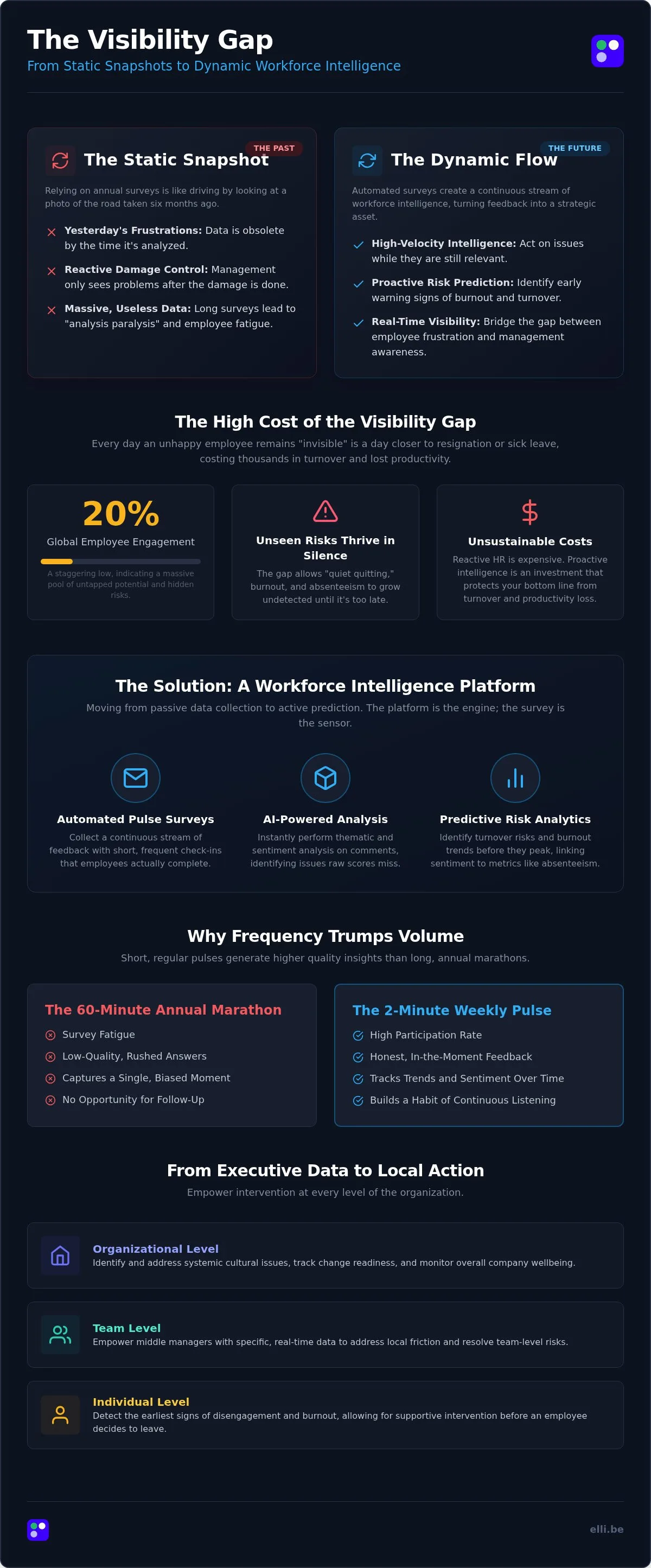
High-frequency data smooths out the noise. When you collect feedback every week, a temporary project crisis doesn’t ruin your yearly engagement score. You see the trend line, not just the spike. This consistency builds a culture of self-leadership. Employees become accustomed to reflecting on their own wellbeing and productivity regularly. Feedback stops being a corporate event and starts being a professional habit. It bridges the gap between the workforce and leadership through constant, low-stakes connectivity.
The Science of Survey Fatigue
The most common objection to frequent feedback is survey fatigue. This is a misunderstanding. Employees don’t suffer from survey fatigue; they suffer from action fatigue. They stop responding when they believe their input leads to zero change. Intelligent automation prevents burnout by rotating question banks. Instead of asking the same ten questions every week, the system intelligently cycles through different drivers like autonomy, growth, and alignment. In 2026, the optimal feedback frequency is a two-minute weekly pulse that prioritizes consistency over comprehensiveness. This keeps the experience fresh while ensuring no strategic driver is ignored for more than a month.
Capturing the “Employee Voice” in Real-Time
Micro-feedback is the only way to manage fast-changing environments. If your organization is undergoing a digital transformation or an AI integration, sentiment can shift in days. Waiting for an annual report is a tactical error. Frequent pulses allow you to track your Employee Net Promoter Score (eNPS) with precision. You can see exactly how a specific leadership announcement or policy change impacts morale within 48 hours.
Consider a rapid organizational pivot. Companies that rely on high-velocity feedback loops can course-correct before resistance hardens into turnover. They treat the employee voice as a real-time navigation system. By the time a competitor realizes their team is unhappy, the data-driven leader has already implemented a solution. This isn’t just about being a “supportive” employer. It’s about maintaining operational momentum in a market that doesn’t wait for annual reports.
Designing Your Automated Strategy: A 2026 Framework
Legacy HR asks questions. Modern leadership builds systems. To move beyond the limitations of manual data, you need a structured framework that aligns your automated employee surveys with business objectives. This isn’t about asking more questions. It’s about asking the right ones at the exact moment they matter. Generic feedback is a liability. Strategic intelligence is an asset.
A robust 2026 framework requires four critical steps:
- Step 1: Define Strategic Drivers. Determine if you’re solving for retention, wellbeing, or large-scale organizational change.
- Step 2: Map Lifecycle Triggers. Automate feedback for key transition points like onboarding, internal mobility, and exit interviews.
- Step 3: Establish the Action Loop. Define exactly who receives the data and the specific timeframe for executive or managerial response.
- Step 4: Integrate Specialized Assessments. Move beyond general sentiment to include targeted modules for AI readiness and change readiness.
This methodical approach transforms a software tool into a high-velocity intelligence system. It ensures that every data point serves a specific executive goal rather than just filling a database. By mapping these triggers, you close the visibility gap mentioned earlier in this article.
Integrating AI and Change Readiness
The 2026 workforce faces unprecedented technological shifts. Measuring generic engagement isn’t enough. You must quantify “AI Anxiety” and digital adoption rates. Change readiness is now a core workforce competency, not a one-off project. Automated surveys provide the continuous visibility needed to support workforce sustainability during rapid pivots. They allow you to detect resistance before it becomes a cultural barrier. You can’t manage what you don’t measure.
Setting the Right KPIs for Automation
Participation rates are a vanity metric. If 90% of your staff responds but zero actions are taken, the system has failed. Shift your focus to “Action Rate.” This measures how quickly managers address the flags raised by the platform. A workforce intelligence dashboard should provide the C-Suite with a real-time health score, correlating sentiment with absenteeism and turnover. This creates a bridge between raw data and executive action.
Stop guessing about your team’s ability to adapt. Evaluate your organization’s workforce risk analytics to secure your strategic future.
Beyond Data: Turning Automation into Workforce Sustainability
Data collection is a commodity. Intelligence is a competitive advantage. In the Belgian corporate context, where talent scarcity and burnout are persistent threats, the ability to nurture workforce sustainability is paramount. By implementing automated employee surveys, you move from the reactive anxiety of managing people to the proactive confidence of nurturing workforce intelligence. Automation doesn’t replace the human element. It protects it.
Leaders often fear that automation de-personalizes the workplace. The opposite is true. By removing the guesswork, you create a more human environment. You address the specific pains of your team before they escalate. This is the essence of workforce intelligence. It isn’t just about efficiency. It’s about connectivity. It’s about bridging the gap between raw data and executive action. You gain the relief of control over complex human systems. You shift from uncertainty to clarity.
Empowering Leaders with Actionable Insights
Manual reporting is a bottleneck. It forces HR into the role of a data police force, constantly chasing participation. Automation changes the dynamic. HR becomes a strategic advisor. elli distills complex sentiment data into clear priorities for department heads. Managers don’t get a spreadsheet. They get a roadmap. This reduces the administrative burden on HR teams. It allows focus on high-level cultural strategy instead of manual analysis. Local action becomes the default. Feedback isn’t just stored; it’s utilized.
This transition empowers middle management. In many Belgian enterprises, managers feel caught between executive demands and team needs. Automated insights provide them with the evidence required to make local changes. They can see exactly where a team is struggling with AI integration or where wellbeing is dipping. They stop guessing. They start leading. This is how you build a high-velocity workforce intelligence system that predicts risks before they impact your bottom line.
The Future of Workforce Health
The horizon for 2027 and beyond focuses on predictive sustainability. Organizations will no longer just react to turnover. They will engineer stability. Workforce sustainability is the ultimate competitive advantage in a volatile market. It requires a system that detects friction before it becomes a crisis. In 2027, the focus will shift toward change readiness as a permanent state. Organizations won’t just undergo change; they will be built for it. This requires a continuous intelligence loop that operates in the background. Sustainability isn’t a goal. It’s a requirement.
Protecting your human capital is a strategic necessity. It’s the difference between a resilient organization and one that collapses under the weight of its own visibility gap. The technology exists to see what others miss. The only question is whether you’re ready to look. Detect your workforce risks early with elli.
Securing the Future of Your Workforce Intelligence
The transition from annual snapshots to continuous listening is no longer optional. It’s a strategic necessity. By implementing automated employee surveys, you eliminate the visibility gap that threatens organizational stability. You trade stale data for real-time velocity. This shift allows you to detect workforce risks before they manifest as turnover or burnout. Static feedback belongs to the past; dynamic intelligence defines the future.
Effective leadership in 2026 requires more than just listening. It requires the ability to predict. With specialized AI anxiety and change readiness assessments, you gain a clear roadmap for organizational transformation in the Belgian market. Real-time workforce risk analytics bridge the gap between employee sentiment and executive action. You don’t just manage people. You nurture workforce sustainability. It’s time to move from reactive anxiety to proactive leadership. Clarity is your ultimate competitive advantage.
Start turning your workforce data into strategy with elli. Protect your retention rates and secure your competitive advantage today. Your most valuable assets deserve a proactive guide.
Frequently Asked Questions
What are automated employee surveys and how do they work?
Automated employee surveys are digital intelligence loops that distribute feedback requests based on predefined schedules or behavioral triggers. They eliminate the manual burden of HR distribution by sending short, targeted questions via email or internal chat. Responses flow directly into a centralized dashboard for immediate sentiment analysis. This replaces static, manual reporting with a dynamic stream of workforce insights. It’s the bridge between raw sentiment and executive action.
How do automated surveys help prevent survey fatigue?
They prevent fatigue by prioritizing brevity over depth. Most employees don’t hate feedback; they hate long, irrelevant forms that take an hour to complete. Automation rotates question banks to keep the experience fresh and relevant. By limiting surveys to two minute touchpoints, you respect the employee’s time. Fatigue disappears when people see their micro feedback leads to tangible changes in their daily work environment.
Can automated surveys really predict employee turnover?
Predictive analytics identify turnover risks by spotting red flag sentiment patterns early. When automated employee surveys detect a sharp decline in growth satisfaction paired with rising workload anxiety, the system flags a high resignation risk. This allows for proactive retention strategies. You solve the problem before the employee even updates their CV. It turns reactive HR into strategic risk management.
How often should we send automated pulse surveys in 2026?
The optimal frequency in 2026 is a weekly or bi-weekly pulse. This cadence captures the nuances of modern hybrid work that annual surveys miss. Rare surveys only capture extreme highs or lows, which distorts the truth. Frequent touchpoints provide a smoothed trend line that reflects the true health of the organization. Consistency is the only way to eliminate recency bias and ensure data remains actionable.
Are automated employee surveys anonymous?
Anonymity is guaranteed through data aggregation and strict access controls. In Belgium, GDPR compliance requires that individual responses remain private to protect employee rights. Most platforms require a minimum threshold of respondents before displaying team level data. This protects the individual while giving the manager enough visibility to address systemic issues. Privacy isn’t just a legal requirement; it’s a fundamental trust builder.
What is the ROI of an automated workforce intelligence platform?
ROI is calculated by comparing the platform cost against the savings from reduced turnover and absenteeism. A single resignation in a Belgian firm can cost upwards of €50,000 in recruitment and lost productivity. If the platform prevents just two such exits per year, the return is immediate. It transforms HR from a cost center into a value protector by securing your most expensive assets.
How do automated surveys support change management and AI adoption?
They measure specific competencies like AI readiness and digital anxiety through specialized assessments. Change is constant; your data should be too. These automated employee surveys identify exactly where resistance exists in the adoption curve. Instead of guessing why a new tool is failing, you receive direct feedback on training gaps or technical friction. It’s the difference between a forced rollout and a supported transition.
What is the difference between a pulse survey and an automated lifecycle survey?
A pulse survey is a recurring check-in for the entire organization to measure cultural health. A lifecycle survey is a triggered event based on an individual’s journey, such as onboarding or exit. One measures the collective climate; the other measures specific milestones. Using both ensures that you capture both systemic trends and individual experiences without any manual oversight or administrative lag.